Progress Claims vs Actual Progress: What Client-Side Teams Should Be Checking
A progress claim is a commercial document; actual progress is a physical reality. This article explains what client-side teams should check when comparing claimed progress with programme status, site evidence, quantities, milestones and forecast completio
Nov 3, 2026
Programming & Project Controls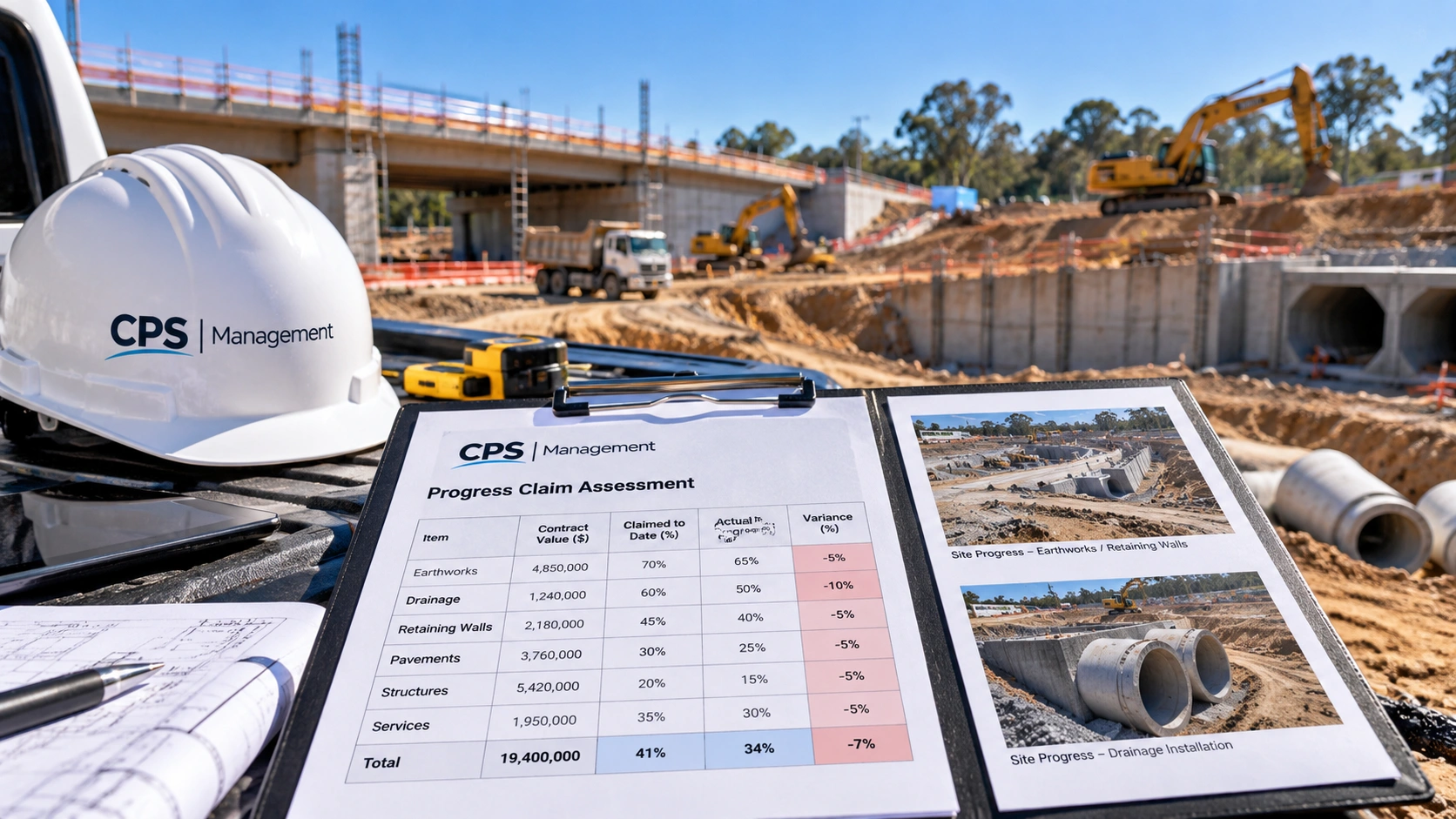
A progress claim is a commercial document.
Actual progress is a physical reality.
The two should broadly align — but they do not always tell the same story.
For developers, project managers, superintendents and other client-side teams, assessing a progress claim should involve more than checking a percentage against a spreadsheet.
The key question is:
Does the available evidence support the progress being claimed?
That means looking at programme status, physical work, quantities, procurement, milestones and supporting records.
Why the distinction matters
Construction projects use several measures of progress, including:
• Physical progress on site
• Programme progress
• Cost incurred
• Value of work completed
• Materials purchased or delivered
• Milestones achieved
• Forecast completion
These measures are related, but they are not interchangeable.
A project may be financially advanced while important physical work remains incomplete. Likewise, materials may have been purchased without being installed.
That is why claimed progress needs to be tested against evidence.
1. Understand the contractual basis
Before assessing percentages, understand how the contract deals with payment.
Claims may be based on:
• Schedule of rates
• Milestones
• Percentage completion
• Measured quantities
• Lump-sum breakdowns
• Off-site materials
• Approved variations
The assessment should follow the relevant contractual mechanism.
Technical progress analysis can support that assessment, but contractual and legal determinations remain with the appropriately appointed contract administrator or adviser.
2. Compare claimed progress with physical progress
Look at what has actually been completed.
Useful evidence can include:
• Site inspections
• Photographs
• Installed quantities
• Survey information
• Inspection and test records
• Daily reports
• Delivery records
• Commissioning records
If a work package is claimed as substantially complete, the physical evidence should support that position.
3. Compare the claim with the programme
The current programme provides another important reference point.
For significant items, ask:
• Was the activity planned to be complete by now?
• What percentage does the programme report?
• Is the activity actually complete?
• Has its finish date moved?
• Is it on or near the critical path?
• Has downstream work commenced as expected?
Programme information should not automatically determine payment, but significant differences between programme status and claimed progress deserve explanation.
4. Be careful with percentage complete
Percentage complete can be subjective.
An activity reported as 80% complete might mean:
• 80% of quantities installed
• 80% of labour hours spent
• 80% of budget consumed
• 80% of an internal weighting achieved
• A subjective estimate
Those measures can produce very different results.
Where possible, objective measurement is preferable.
5. Check quantities where possible
Quantity-based progress can provide strong supporting evidence.
Examples include:
• Cubic meters of concrete placed
• Tonnes of steel installed
• Meters of pipe installed
• Square meters of façade completed
• Number of piles installed
• Equipment units installed
If the total quantity is known and installed quantities can be verified, the physical progress percentage becomes easier to substantiate.
However, installation may still need to be followed by inspection, testing or commissioning before the contractual value is fully earned.
6. Look closely at materials and procurement
Claims involving materials require particular attention.
Ask:
• Have the materials been ordered?
• Have they been manufactured?
• Have they been delivered to site?
• Are they clearly identified for the project?
• Does the contract permit payment for off-site materials?
The commercial value of a purchase does not automatically equal physical progress.
7. Check whether milestones are genuinely achieved
Where payment is linked to milestones, the milestone definition matters.
A milestone such as Mechanical Completion may require more than installation.
It could also require:
• Inspections
• Testing
• Documentation
• Defect closure
• Certification
• Client acceptance
Progress assessments should therefore confirm whether all required conditions have actually been achieved.
8. Consider incomplete and defective work
Work can be installed without being fully acceptable.
Review:
• Outstanding defects
• non-conformances
• Failed inspections
• Incomplete testing
• Missing documentation
• Rework requirements
• Unfinished interfaces
A high claimed percentage can conceal significant remaining effort if incomplete or defective work is ignored.
9. Review variations separately
Variations can complicate progress claims.
For each significant variation, consider:
• Has it been instructed or agreed?
• What work has actually been performed?
• What valuation basis is being used?
• Is the claimed percentage supported?
• Is the same work already included elsewhere?
Keeping original scope and variation work clearly separated reduces the risk of duplication.
10. Look for front-loading
Front-loading occurs when disproportionate value is allocated to early activities.
For example, unusually high value may be attached to mobilization, early procurement or preliminary activities.
This can result in payment progressing faster than physical delivery.
A financially advanced project is not necessarily a physically advanced project.
11. Compare progress trends over time
One month's claim may look reasonable in isolation.
The trend can tell a different story.
Track:
• Claimed progress each month
• Actual physical progress
• Programme progress
• Milestone movement
• Forecast completion
• Previous assessment adjustments
If claimed progress continues increasing while milestone dates and completion forecasts move out, the difference deserves attention.
12. Consider the remaining work
A project can reach 80% complete and still have significantly more than 20% of the delivery challenge remaining.
The final stages often include:
• Testing
• Commissioning
• Integration
• Defect rectification
• Authority inspections
• Documentation
• Certification
• Handover
These activities can be difficult and time-consuming.
Progress assessments should therefore consider both work completed and the nature of the work remaining.
What should client-side teams be asking?
A practical progress review should ask:
• What has physically been completed?
• What evidence supports the claimed percentage?
• What does the programme report?
• Are quantities measurable?
• Are claimed milestones actually achieved?
• Are materials installed, delivered or still off site?
• What defects or incomplete work remain?
• Are variations clearly separated?
• Does financial progress broadly align with physical progress?
• Are forecast completion dates consistent with the level of progress reported?
Not every difference means something is wrong.
But significant differences should be understood before a claim is accepted.
Programme and progress assessment should work together
Commercial, programme and physical progress information are strongest when reviewed together.
The programme shows what should have been completed and what remains.
Site evidence shows what has actually been delivered.
Commercial information shows the value being claimed.
Together, these provide a much clearer view of project performance.
The objective is evidence-based decision-making
Progress claims should not become an argument about competing percentages.
The strongest assessments are based on evidence.
When commercial information, programme status and physical delivery align, decision-making becomes much easier.
When they do not, the difference needs to be understood.
CPS Management provides independent programme, progress and claims assurance for developers, project managers, superintendents, contractors and client-side teams.
The focus is on providing a clear technical view of programme status, observable progress, supporting evidence and emerging delivery risk.